


Updated: June 4, 2026
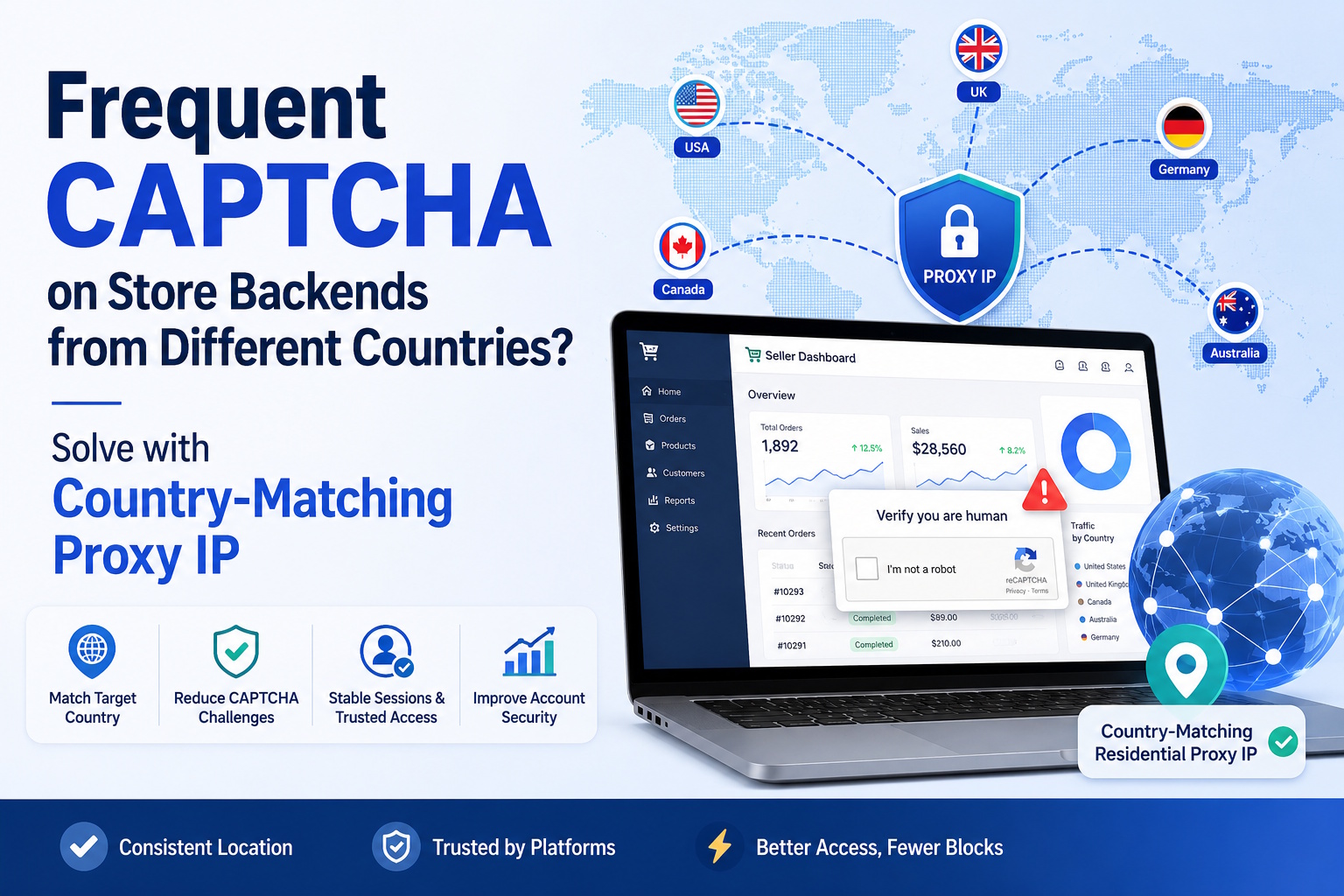
If store backend CAPTCHA appears after cross-border logins, mixed team locations, or unstable repeat sessions, a Country-Matching Proxy IP is usually worth testing. For daily seller operations, account settings, order handling, and other long-session work tied to one market, static residential proxy IP is usually the safer fit because location consistency and session stability matter more than rotation. For short market checks or temporary validation work, dynamic residential proxy IP is often the more practical choice. If the trigger came from account risk, device changes, or unusual behavior, proxy IP can improve the network signal but will not solve the root cause by itself.
If you are choosing a proxy only by price, country count, or package size, it is easy to buy the wrong setup. What matters first is whether the backend task needs a fixed country, a long-lived session, frequent switching, or lower-cost uptime. That is the decision path that determines whether country-matching proxy IP is worth the spend.
When is a country-matching proxy IP worth paying for after store backend CAPTCHA?
A country-matching proxy IP is usually worth paying for when the store backend is operated repeatedly in one target market and the CAPTCHA pattern appears after country mismatch, region drift, or unstable session continuity. It is less convincing when the issue started right after password resets, browser resets, new devices, payment changes, permission edits, or unusual action speed. In those cases, the platform may already be reacting to account-side risk rather than just the network path.
Does daily store management need a stable country-matching proxy IP?
Daily store work often needs a more stable setup than occasional checks. Order handling, listing edits, merchant center reviews, payout checks, and account settings are long-session tasks, so the main requirement is not a large IP pool but a consistent login country and a stable session pattern. That is where static residential proxy IP is usually the safer fit. It helps when the store, operator, and target market are expected to stay aligned over time.
This fit is weaker when the backend is opened only once in a while. For one-off catalog checks, temporary support access, or short compliance reviews, a simpler setup may be enough. In those cases, it is better to first ask whether the task really needs a long-term country-matched identity or whether cleaner device handling and fewer logins would solve more.
When does account risk matter more than the proxy IP?
If CAPTCHA spikes after a password reset, new device, browser reset, permission change, or unusual activity burst, proxy IP is rarely the first fix. The backend may already be reacting to account history or behavior rather than to location mismatch alone. A more stable IP can still reduce noise, but it cannot rebuild account trust or replace compliant operations.
That is why the first diagnostic step should be narrow: keep one browser profile, one operator, and one target country stable for several days. If CAPTCHA frequency falls after only the network path changes, proxy fit is probably part of the solution. If not, the bigger issue is likely account-side.
Which store backend tasks are the best fit for country-matching proxy IP?
The strongest fit is not “any backend with CAPTCHA,” but backend work where country consistency is part of normal operations. A country-matching proxy IP makes the most sense when the platform expects the business region, operator region, and session behavior to stay predictable across repeated use.
Which seller dashboard tasks care most about location consistency?
Seller dashboards, merchant centers, ad account panels, and payment-related back offices usually care more about region consistency than concurrency. These workflows do not need constant IP rotation. They need the login path to stay coherent: same market, same operator pattern, and fewer abrupt location changes. That is why country-matching proxy IP is easier to justify for long-term backend work than for broad multi-market testing.
If the task is mainly dashboard management tied to one region, static residential proxy IP is usually the first type to compare. If the work is only localized observation, quick validation, or temporary support, paying for a long-session setup may be harder to justify.
When does shared team access create more CAPTCHA than the wrong proxy?
If several staff members use the same backend from different locations, shared access design may create more friction than the proxy type itself. One admin account used across countries and time zones is a common source of repeated verification. In that case, buying more IPs without changing permissions or operator structure often adds cost without reducing the real problem.
The better move is usually to separate roles, reduce overlapping logins, and decide which operators actually need dedicated proxy IP resources. If regular backend access still depends on one fixed market after that cleanup, country-matching proxy IP becomes much easier to justify.
Which proxy IP type fits store backend CAPTCHA best?
The right proxy IP type depends on whether the backend task is long-session account work, short market validation, or lower-risk traffic where uptime and cost matter more than residential identity. Buying only on the word “residential” is not enough. The real question is how the session behaves.
When is static residential proxy IP the better fit?
Static residential proxy IP is usually the safer choice when the same operator needs repeated login access to the same store backend over days or weeks. It fits order handling, listing edits, ad checks, account settings, and other workflows where a stable identity matters more than rotation. If the platform expects continuity, frequent IP changes often make the pattern look less natural rather than more flexible.
This type is less efficient when the work is spread across many markets or many short checks. In those cases, paying for fixed-session stability can be more than the task actually needs.
When is dynamic residential proxy IP enough?
Dynamic residential proxy IP is usually more practical for short verification, localized checks across several countries, temporary storefront reviews, and lighter research tasks. These jobs care more about flexibility and cost control than about keeping one IP for long periods.
It is a weaker default for repeated backend operations under one account. If the store backend is used every day and the platform expects stable location behavior, too much rotation can increase verification rather than reduce it.
When is static datacenter proxy IP still worth testing?
Static datacenter proxy IP can make sense when cost efficiency and uptime matter more than residential-looking traffic. For simpler internal workflows, lower-risk sites, or less sensitive access layers, it can be a reasonable option. The tradeoff is that stricter store backends may reject it sooner when they inspect IP type, login consistency, or traffic patterns more closely.
That means static datacenter is often a later comparison rather than the first answer for repeated store backend CAPTCHA. If the backend is already sensitive, static residential is usually the more realistic first benchmark.
What should you compare before choosing a provider for store backend CAPTCHA?
Provider comparison should start with task fit, not with marketing labels. If the store backend needs one fixed country, long session continuity, and stable repeated login behavior, those requirements matter more than raw package size. If the task is short, multi-market, or exploratory, cost model and switching flexibility may matter more.
Why does country match matter more than country count?
For store backend CAPTCHA, the useful question is not how many countries the provider lists. The real question is whether the provider can give you the exact country or region your business needs and keep that location stable enough for the backend workflow. If the store is tied to one market, one precise region is often more valuable than a broad international list.
How does billing model change the real cost?
Time-based products are usually easier to justify for long admin sessions because the workload depends on stability more than on traffic spikes. Traffic-based products often fit short-lived checks and lighter research better because the task does not depend on one persistent session. The wrong billing model can make a technically usable proxy feel expensive very quickly.
What should you confirm before rollout?
Before rollout, confirm protocol support, authentication method, session behavior, concurrency expectations, and support response quality. If the provider cannot help you distinguish between IP-side issues and account-side issues during a trial, that is already part of the buying decision. If you want a reference point while comparing options, review Learn about GloablProxy services and match the product type to your workflow before committing.
How should you test a country-matching proxy IP before scaling?
The best test is not a generic IP checker. It is the real backend workflow in the target country. Run one operator, one browser profile, one store flow, and one proxy type first. Then watch CAPTCHA frequency, login success, session continuity, and whether the backend still behaves like the right market over several days.
If the result improves only when the network path changes, proxy fit is likely part of the solution. If CAPTCHA remains the same, the issue probably sits more with the account, device pattern, permissions, or platform-side review rules than with the IP itself.
FAQ
Can a proxy IP completely stop store backend CAPTCHA?
No. It can reduce location inconsistency and unstable session signals, but it cannot replace compliant account operations or fix account-side risk by itself.
Is a country-matching proxy IP always better than a cheaper global option?
No. It is usually better only when the backend task depends on one fixed market and stable repeated logins. For broader checks or short validation work, a simpler option may be enough.
Should I choose SOCKS5 for store backend CAPTCHA issues?
Choose SOCKS5 only when your workflow includes tools or traffic types that need it. For browser-heavy backend work, HTTP or HTTPS is often enough if the session pattern is stable.
How should I compare pricing for store backend proxy IPs?
Compare by billing model, session need, target country stability, and support quality, then confirm current plan details on the official purchase page or in the dashboard.