


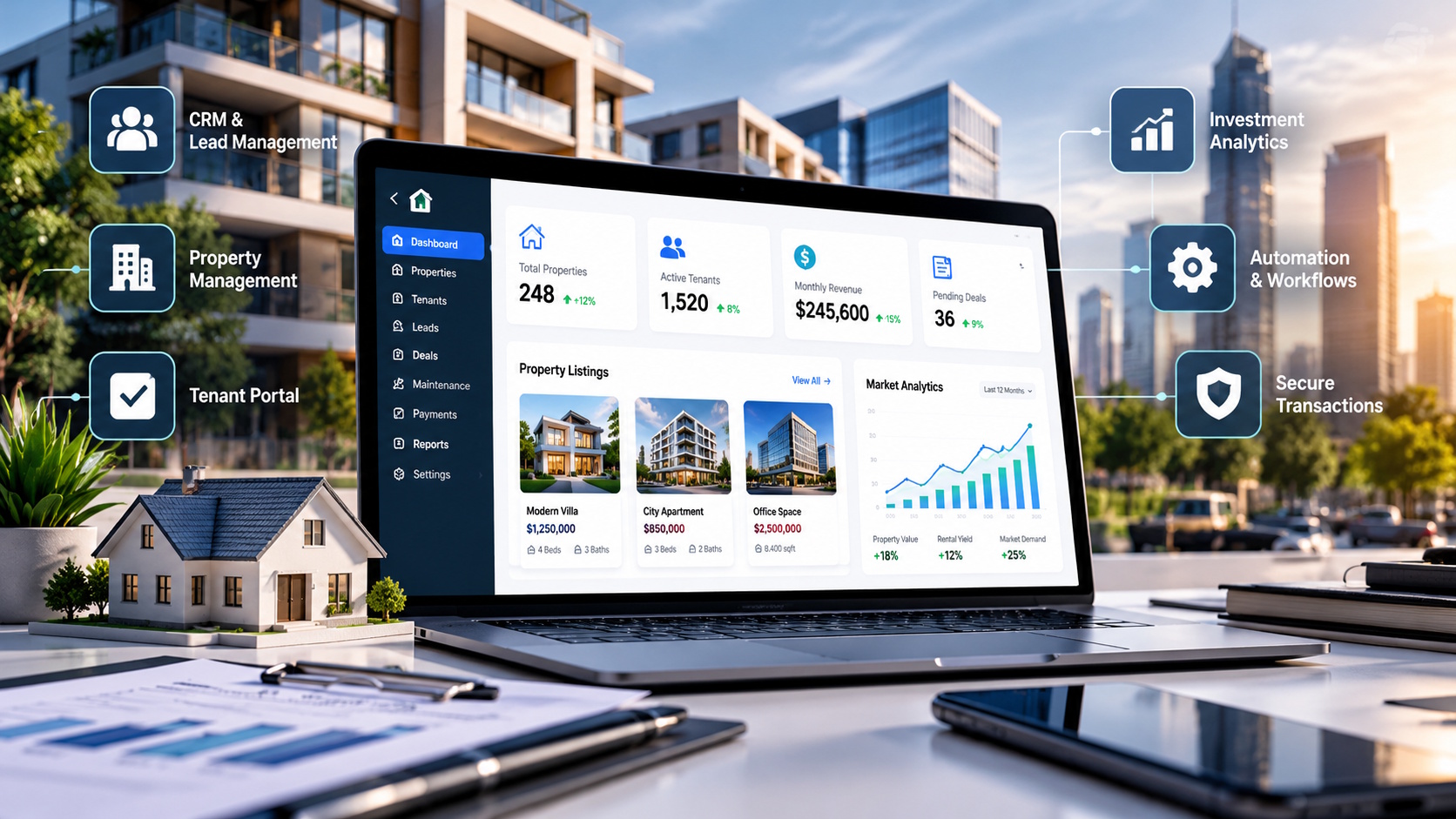
The global real estate sector, historically characterized by paper-heavy transactions, fragmented communication, and traditional relationship-building, is undergoing a profound digital transformation. Today’s property managers, commercial brokers, and real estate investors face an increasingly complex landscape defined by shifting tenant expectations, volatile market dynamics, and the constant influx of massive data sets. Relying on generic, out-of-the-box software often forces these professionals to adapt their proprietary workflows to rigid technological limitations, resulting in data silos and operational bottlenecks. To truly gain a competitive edge and build scalable operations, modern agencies and investment firms are increasingly turning to custom software development for real estate industry to architect tailored digital infrastructures. By engineering bespoke platforms that align perfectly with their unique business models, real estate enterprises can automate tedious administrative tasks, unlock actionable market insights, and deliver a frictionless, modern experience for buyers, sellers, and tenants alike.
The Bottlenecks of “One-Size-Fits-All” Solutions
The enterprise software market offers a plethora of Software-as-a-Service (SaaS) products aimed at real estate professionals. While these platforms can be useful for smaller, newly established agencies, they inevitably become a liability for growing enterprises. The “one-size-fits-all” approach assumes that a boutique residential brokerage operates the same way as a multinational commercial property management firm, which is fundamentally incorrect.
The Problem of Data Silos and Feature Bloat
Off-the-shelf PropTech (Property Technology) solutions are often bloated with hundreds of generic features that a specific company may never use, yet still pays for through escalating licensing fees. Conversely, they frequently lack the highly specific, niche functionalities that a company actually needs. This leads to a fractured IT ecosystem: the accounting department uses one application for payroll, agents use a disconnected Customer Relationship Management (CRM) tool to track leads, and property managers rely on a third, isolated portal to handle tenant requests. This fragmentation requires employees to manually export and cross-reference data, introducing severe risks of human error and severely delaying critical business intelligence reporting.
Core Pillars of a Tailored Real Estate Architecture
When an organization chooses to develop its own proprietary software, it gains the ability to build a centralized, cohesive ecosystem where all departments operate from a single source of truth. A custom-engineered platform typically focuses on optimizing three core operational pillars.
1. Advanced CRM and Pipeline Automation
A real estate transaction is rarely a simple, linear process; it involves months of lead nurturing, property showings, negotiations, and complex legal paperwork. A custom CRM can be designed to mirror a brokerage’s exact sales funnel. It allows for the seamless integration of Multiple Listing Service (MLS) data via RETS or WebAPI feeds, ensuring that agents have real-time access to the most accurate property data without leaving their dashboard. Furthermore, customized automation can trigger personalized follow-up emails, schedule viewing appointments, and alert agents when a high-value prospect interacts with a specific digital property listing.
2. Comprehensive Property and Tenant Management
For property management firms, the daily logistical overhead can be overwhelming. Bespoke software transforms this dynamic by introducing centralized tenant portals. Through a custom application, tenants can digitally sign leases, set up automated ACH rent payments, and submit maintenance requests complete with photo attachments. On the backend, property managers can automatically dispatch these work orders to approved local contractors, track the repair status, and automatically update the property’s ledger—reducing a process that used to take days into a matter of minutes.
3. Data-Driven Valuation and Investment Analytics
Real estate investors and commercial developers rely on hyper-accurate data to assess risk and forecast profitability. Custom platforms can be engineered to pull in diverse, real-time datasets—such as local zoning laws, historical tax assessments, demographic shifts, and predictive neighborhood gentrification metrics. By utilizing customized algorithms to calculate Cap Rates, Cash-on-Cash returns, and Net Operating Income (NOI) in real-time, investment firms can identify lucrative off-market opportunities long before their competitors relying on standard commercial databases.
Emerging Technologies Shaping Custom PropTech
Building a proprietary system allows a company to integrate cutting-edge, next-generation technologies that legacy software providers are often too slow to adopt. When architecting a modern real estate platform, forward-thinking firms are leveraging the following innovations:
- Artificial Intelligence and Machine Learning: AI algorithms are being deployed to analyze decades of historical market data to predict future property price fluctuations with startling accuracy. Additionally, AI-driven chatbots on agency websites can handle initial lead qualification 24/7, answering complex questions about square footage, HOA fees, or school districts before seamlessly handing the warm lead over to a human agent.
- The Internet of Things (IoT): For property managers, IoT integration is a game-changer. Custom software can connect to smart building sensors to monitor HVAC efficiency, detect early signs of plumbing leaks, and manage ambient lighting in commercial spaces. This predictive maintenance approach saves thousands of dollars by addressing physical infrastructure issues before they escalate into catastrophic failures.
- Virtual and Augmented Reality (VR/AR): Custom applications are increasingly incorporating high-fidelity 3D modeling and immersive virtual tours. This technology allows international buyers or out-of-state investors to perform comprehensive property walk-throughs from their smartphones, drastically accelerating the decision-making process and expanding the brokerage’s reachable market.
- Blockchain and Smart Contracts: To combat the notoriously slow and opaque nature of real estate closings, custom platforms are beginning to utilize distributed ledger technology. Blockchain ensures that title deeds, escrow funds, and identity verifications are cryptographically secured, while smart contracts can automatically execute the transfer of funds and ownership the moment all predefined legal conditions are met.
The Strategic ROI of Custom Development
The hesitation that many real estate executives have regarding custom software development usually stems from the initial capital expenditure. It is true that building a proprietary platform requires a more significant upfront investment than purchasing a monthly SaaS subscription. However, evaluating enterprise software solely through the lens of initial cost is a strategic misstep; the focus must be on the Total Cost of Ownership (TCO) and the long-term Return on Investment (ROI).
With a bespoke system, an agency completely eliminates per-user licensing fees, which inherently penalize a company for growing its workforce. Furthermore, the organization is protected from sudden vendor price hikes or the risk of a third-party software provider unexpectedly going out of business.
Beyond direct financial savings, there is the critical issue of data ownership and cybersecurity. Real estate transactions involve vast amounts of Personally Identifiable Information (PII) and sensitive financial data. Utilizing a patchwork of third-party applications increases the surface area for cyberattacks. A custom-built platform allows a firm to implement enterprise-grade security protocols, end-to-end encryption, and role-based access controls, ensuring strict compliance with regulations like the GDPR and CCPA.
Navigating the Implementation Process
Transitioning from legacy systems to a customized digital infrastructure requires deliberate planning. The most successful deployments utilize an Agile development methodology. Rather than attempting a massive, all-at-once overhaul that disrupts daily operations, experienced development teams build out the software iteratively.
Typically, this begins with defining a Minimum Viable Product (MVP)—the core set of features absolutely necessary to run the business, such as the central CRM database and basic MLS integration. Once the MVP is deployed and adopted by the staff, the development team can seamlessly integrate secondary modules, such as the automated accounting suite or the tenant-facing mobile application, based on live user feedback.
Additionally, a modern API-first (Application Programming Interface) architecture is crucial. Even a custom platform may occasionally need to interact with specialized third-party tools, such as a major banking gateway for payment processing or a municipal database for tax records. An API-first design ensures that the proprietary software remains highly modular and capable of securely exchanging data with external systems without compromising its internal integrity.
In a sector where multi-million dollar deals pivot on speed, accuracy, and client trust, technology can no longer be viewed merely as an administrative support tool; it is the primary engine of modern business strategy. As the industry continues to evolve, the gap between digitally agile firms and those clinging to outdated, generic software will only widen. By investing in tailored digital architecture, real estate enterprises can break free from the constraints of legacy systems, unify their operational data, and build a highly scalable, future-proof foundation that empowers their agents and delights their clients.