


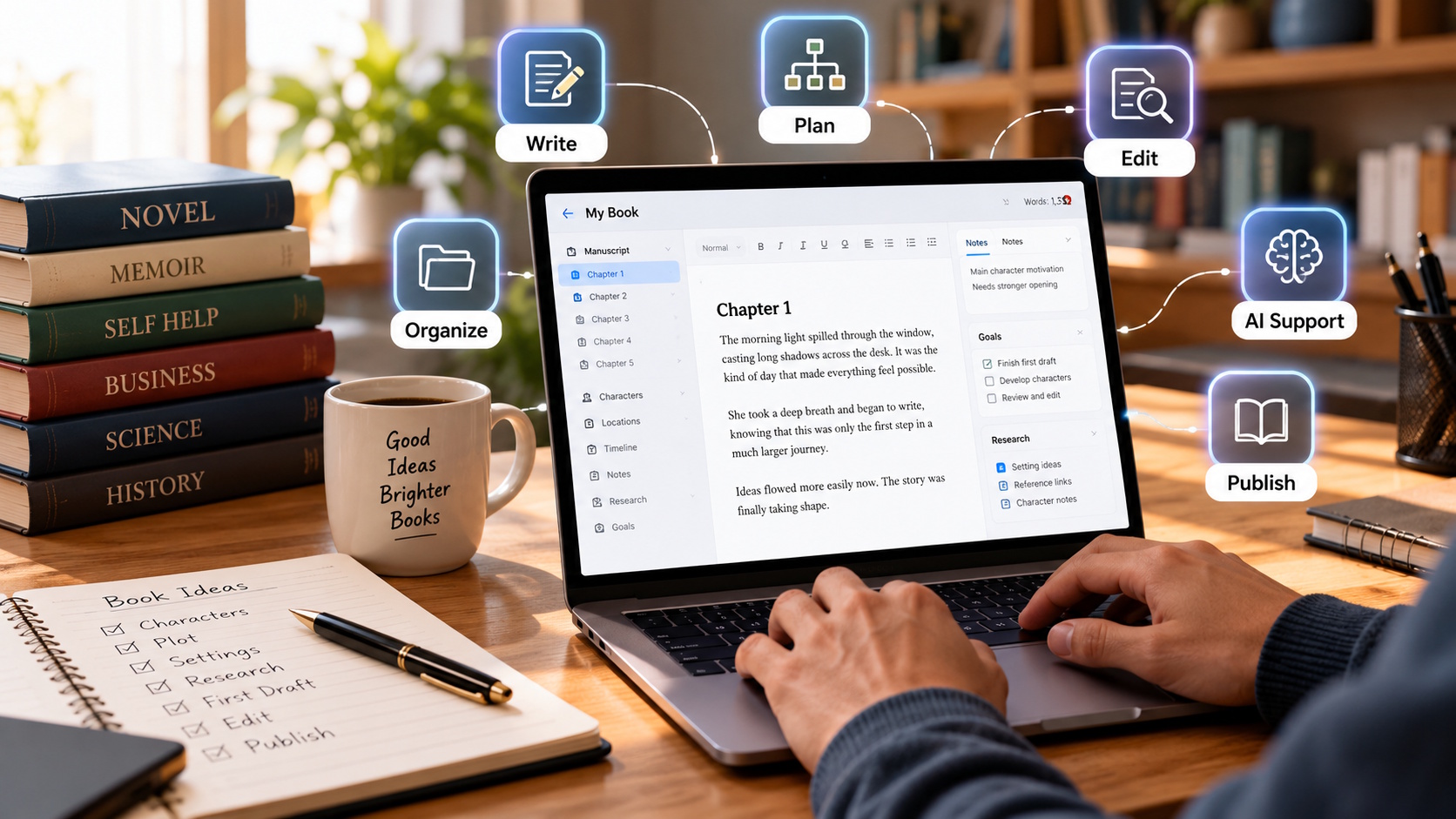
Search for book writing software and you will find dozens of options, each promising to be the one that finally gets your book finished.
The truth is less exciting. The right tool depends on how you write, what kind of book it is, and which part of the process you find hardest.
This guide walks through the decisions that actually matter, so you can choose once and get back to writing.
Start with your bottleneck, not the feature list
Every writer gets stuck somewhere different. Before you compare products, decide where you lose the most time.
- Starting: you have ideas but struggle to get words on the page.
- Organising: your draft is long, messy and hard to navigate.
- Keeping track: characters, timelines and world details slip through the cracks.
- Revising: you finished a draft but cannot tell what is wrong with it.
- Publishing: formatting, covers and store requirements feel overwhelming.
Most software is strong at one or two of these. Buy for your bottleneck.
The main types of book writing software
General word processors. Free or already on your computer. Fine for short books and people who hate learning new tools. They struggle with very long manuscripts and offer no help with structure.
Dedicated manuscript editors. Organise a book by chapter and scene, let you rearrange sections easily, and keep notes alongside the text. A big step up for novels and long non-fiction.
Planning and outlining tools. Visual timelines, beat boards and character databases. Excellent for plotters and complex series.
AI drafting tools. Generate or expand prose from prompts. Useful if you want help producing words, less so if you want every sentence to be yours.
AI analysis tools. Read your manuscript and report on structure, pacing, continuity and characters. Useful for revision, especially before beta readers or an editor.
Formatting tools. Turn a finished manuscript into an ebook and print-ready file.
Some newer tools combine several of these in one place: a writing editor, a story bible, analysis and publishing prep. That can save money and context switching, as long as you actually need most of the pieces.
Seven questions to ask before you buy
1. Does it handle a full-length book without lagging? Test it with your real manuscript, not a demo paragraph.
2. Can you import what you already have? Look for clean import of .docx and other common formats, with chapters detected automatically.
3. Can you get your work out? Export matters as much as import. Make sure you can export to Word, PDF or plain text at any time, and that cancelling does not lock your books away.
4. Does it work where you write? Browser, desktop, phone. If you write on the train, mobile access is not optional.
5. What does the AI actually do? “AI-powered” can mean anything. Find out whether it writes for you, edits you, or analyses you. These are very different products.
6. How is it priced? Flat monthly fee, one-time license, or credits per analysis? If you revise a lot, per-use pricing adds up quickly.
7. What happens to your manuscript? Check that your work stays private and is not used to train AI models.
Fiction and non-fiction need different things
Fiction writers benefit most from tools that track characters, timelines and story structure, and catch continuity errors.
Non-fiction writers need different checks: is the argument sound, are claims supported by sources, is each chapter covering what the outline promised? Some tools handle both, switching their analysis depending on the book type. If you write both, confirm this before you commit.
Free versus paid
A free plan is the best way to test any writing software. Use it on a real chapter, not a sample.
Paid plans usually make sense once you are working on a book every week. Compare the yearly price against what you would otherwise spend on the problem the tool solves. For revision tools, the comparison is a developmental edit, which for a full novel commonly costs four figures.
Do not overbuy
The most common mistake is stacking four subscriptions that overlap. A simple setup covers most writers:
- One place to write and organise the book.
- One tool for revision feedback.
- One tool for final polish or formatting, only when you need it.
For a detailed comparison of specific products by job and price, this roundup of the best book writing software is a good next step.
The bottom line
There is no single best tool for every writer. There is a best tool for your bottleneck.
Figure out where your book keeps getting stuck, test two or three options on a real chapter, and choose the one that removes that friction. Then close the comparison tabs and write.