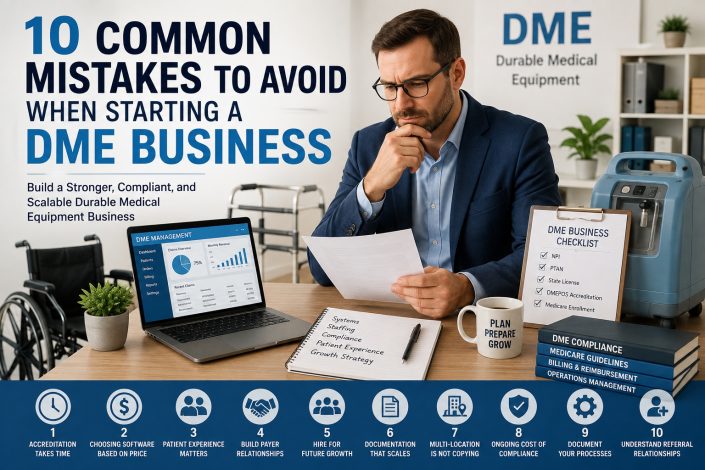
Most guidance on how to start a DME business focuses on the paperwork: NPI, PTAN, state licensing, and DMEPOS accreditation. That part matters, and skipping it isn’t optional if Medicare reimbursement is part of the plan. But it’s also not where most first-time DME entrepreneurs actually struggle once the business is running and the first few referrals start coming in. The mistakes that limit growth tend to show up later, in decisions about systems, staffing, and patient experience that founders didn’t know to plan for on day one. Here are ten of them.
1. Underestimating how long accreditation and enrollment actually take
Getting DMEPOS accreditation, an NPI, a PTAN, and state licensing in place before billing Medicare typically takes several months, not weeks, once surveys, documentation review, and enrollment processing are all accounted for. CMS’s move to annual reaccreditation surveys starting January 1, 2026 means this isn’t a one-time task to check off and forget about once the business opens its doors — it becomes a recurring part of operating the business every year going forward.
2. Choosing software based on price instead of growth plans
Entry-level billing software is often the cheapest option available to a new DME business, and it’s frequently the right choice at first, when volume is low and the founder is still handling most of the billing personally. The mistake is not revisiting that decision as the business adds locations or product lines, which is when a platform chosen for its low starting cost starts creating the workarounds that slow everything down two or three years later.
3. Treating patient experience as secondary to getting equipment out the door
Referral sources — physicians, discharge planners, case managers — remember which DME providers make the process easy for their patients and which ones create friction, and they route future referrals accordingly whether or not anyone says so directly. Founders who understand what DME experience actually means for a patient waiting on equipment at home tend to build referral relationships faster than those focused purely on operational throughput and delivery counts.
4. Not building payer relationships before they’re urgently needed
Waiting until a denial pattern emerges to understand a payer’s specific documentation requirements means learning the hard way, on claims that have already been submitted, delivered, and rejected. Building that knowledge early, even informally through industry associations or peer conversations, pays off the first time a payer changes its rules mid-year without much advance notice to suppliers.
5. Hiring for today’s volume instead of next year’s
A single biller and a single delivery driver can run a small operation reasonably well, but that structure breaks quickly once volume doubles and there’s no slack left to absorb a busy month or an unexpected absence. Planning hiring and role definitions around projected growth, not just current need, avoids the scramble that comes with being consistently understaffed during the exact period the business is trying to expand.
6. Skipping documentation habits that scale
Sloppy documentation is survivable at low claim volume, where a biller can manually catch most issues before submission because there simply aren’t that many claims to check. At higher volume, the same habits produce a denial pattern that’s expensive to unwind, which is why building clean documentation practices early matters more than it seems to at the time, back when volume is still low enough to hide the problem.
7. Assuming multi-location growth will look like copying the first location
Opening a second or third location isn’t the same as replicating the first one, even when the business model and equipment mix stay identical. Different states mean different licensing requirements and different payer mixes, and often different competitive dynamics entirely. Entrepreneurs who plan for that variation from the start scale more smoothly than those who assume what worked once will work everywhere else without adjustment.
8. Underestimating the ongoing cost of compliance, not just the startup cost
DMEPOS accreditation, state licensing renewals, and now annual reaccreditation surveys all carry ongoing costs and staff time that don’t disappear once the business is up and running and the first Medicare claims are getting paid. Founders who budget for accreditation as a one-time expense are often surprised by how much of a recurring annual line item it becomes as the business grows.
9. Not documenting processes as the founder stops doing everything personally
In the early months, the founder often is the billing department, the intake coordinator, and the delivery scheduler all at once, which means processes live in one person’s head rather than in writing anywhere. As the business grows and hires its first real team, that undocumented knowledge becomes a bottleneck exactly when the business needs to move faster, not slower, and exactly when the founder has the least time to sit down and write it all out.
None of these mistakes are fatal on their own, and plenty of successful DME enterprises have made several of them along the way and still grown into large, respected operations. But founders who think through systems, staffing, and patient experience early, alongside the accreditation and licensing steps everyone already expects to handle, tend to spend less time later rebuilding decisions that were made under pressure during the busiest possible moment to fix them.
10. Underestimating how referral relationships shape long-term equipment mix
Founders sometimes choose their initial equipment categories based on personal expertise rather than local referral demand, then spend years trying to build relationships with referral sources who actually need a different mix of equipment entirely. Understanding what local physicians, discharge planners, and case managers need before committing to a narrow product line saves a lot of expensive repositioning down the road.
The common thread across all ten of these mistakes is timing: none of them are wrong decisions in isolation, but each one gets more expensive to fix the longer it goes unaddressed. A software platform that’s outgrown, a documentation habit that’s never been formalized, or a payer relationship that’s never been built all cost relatively little to correct in year one and considerably more to correct in year five, once they’re embedded in how the entire organization operates. First-time DME entrepreneurs who build a little more structure earlier than feels necessary tend to have an easier time scaling past the point where most small operations plateau.