Understanding AI-powered contact center pricing is crucial for businesses evaluating modern customer service solutions. As organizations look to stay competitive, it’s no longer enough to simply handle customer inquiries—today’s customers expect fast, personalized, and consistent support across multiple channels. This raises an important question: what is call center software really offering in 2026?
Modern call center software has evolved far beyond traditional phone systems. Today, it integrates AI-powered features such as intelligent routing, automated responses, sentiment analysis, and predictive analytics. These capabilities not only help reduce operational costs but also improve agent productivity and enhance the overall customer experience. For businesses, understanding these features—and their associated costs—is key to making an informed investment.
Why Businesses Are Considering AI-Powered Contact Centers
AI-powered contact centers are no longer futuristic—they’re essential for competitive customer service. By automating tasks like call routing, ticket prioritization, and chatbot handling, AI reduces agent workloads and speeds up accurate responses.
AI also delivers real-time insights into customer behavior and sentiment, helping managers make data-driven decisions, optimize staffing, and prevent issues before they escalate. It enables personalized interactions at scale, boosting satisfaction and loyalty, especially for businesses handling high call volumes or multi-channel support.
Adopting AI isn’t just about technology—it’s a strategic investment. Companies must weigh costs against benefits like higher productivity, lower churn, and improved customer experience.
Key Factors to Evaluate When Comparing ROI vs Pricing
1. Implementation Costs
The first factor to consider is the initial investment required to deploy an AI-powered contact center. This includes setup fees, software licenses, AI model integration, and the cost of migrating existing systems. Businesses must also account for employee training to ensure agents can effectively use new tools and workflows. While some solutions offer a cloud-based model with lower upfront costs, others may require more extensive IT infrastructure upgrades. Evaluating implementation costs helps organizations understand the short-term financial commitment and plan for a smooth rollout without disrupting current operations.
2. Operational Efficiency
AI-powered contact centers significantly improve operational efficiency by automating routine tasks that previously consumed human agent time. For example, AI can handle call routing based on agent expertise, automatically categorize and prioritize tickets, or respond to common queries through chatbots. These improvements reduce average handling times and free agents to focus on complex, high-value interactions. Companies that measure operational efficiency gains—such as reduced call wait times, lower handling costs, and increased agent productivity—can better assess the ROI of AI adoption.
3. Customer Experience Improvements
Investing in AI-powered contact centers isn’t just about saving costs—it’s about enhancing the customer experience. AI can provide faster response times, personalized interactions, and proactive service by analyzing customer history and predicting needs. Improved customer experience directly impacts loyalty and reduces churn, which has a measurable financial benefit over time. Businesses that track metrics like customer satisfaction scores (CSAT), net promoter scores (NPS), and first-call resolution rates can quantify the value of AI in delivering a superior customer journey.
4. Scalability & Flexibility
One of the biggest advantages of AI-driven contact centers is scalability. Unlike traditional call centers, which require proportional increases in staff to handle higher volumes, AI systems can scale without linear cost growth. This is particularly valuable for businesses experiencing seasonal spikes, rapid growth, or expanding into new channels such as SMS, social messaging, and video chat. Additionally, AI-powered solutions offer flexibility to adapt workflows, integrate new tools, or add advanced analytics without a complete system overhaul, ensuring long-term cost efficiency.
5. Analytics & Insights
Finally, AI-powered contact centers provide real-time analytics and actionable insights that drive smarter business decisions. By analyzing interaction patterns, sentiment, and agent performance, AI helps identify inefficiencies, predict customer needs, and optimize resource allocation. These insights not only reduce operational waste but also uncover opportunities for upselling, cross-selling, and personalized service, which improve revenue. Companies that leverage analytics effectively can achieve higher ROI by continuously refining processes and customer engagement strategies.
Top 5 Contact Center AI Pricing (2026 Edition)
In today’s competitive business landscape, choosing the right AI-powered contact center is crucial for delivering intelligent, efficient, and personalized customer experiences. From automated call routing to sentiment-aware chatbots, Contact Center AI platforms vary widely in features and pricing. Here’s a breakdown of the top 5 solutions, highlighting their pricing and what makes them stand out.
1. Bright Pattern – Best for Seamless Omnichannel Experiences
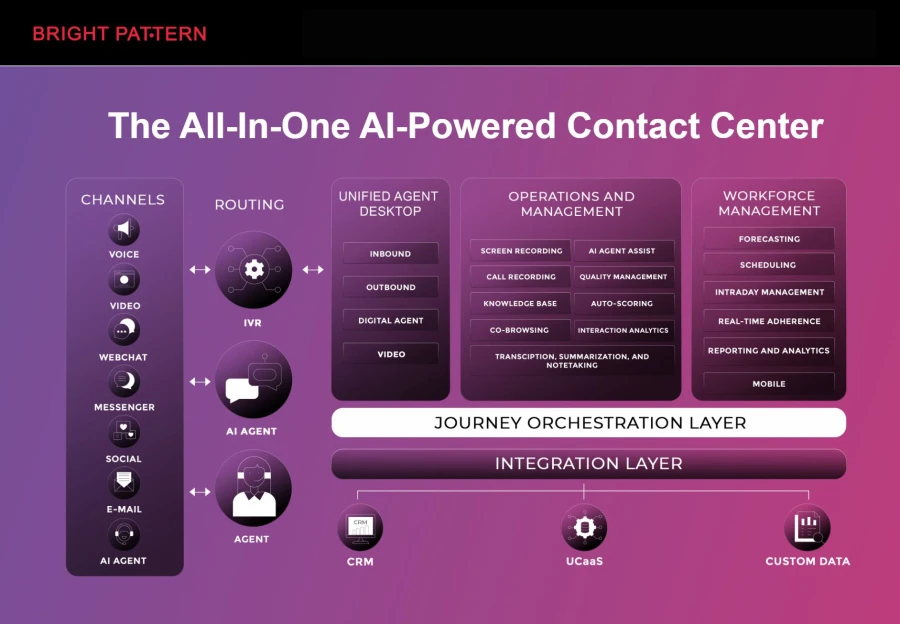
Bright Pattern leads the pack with a flexible pricing model tailored to businesses of all sizes. Its AI-powered contact center platform offers omnichannel support across voice, chat, SMS, email, social messaging, and video, all in a single interface. Pricing starts at $95 per agent/month, with custom enterprise packages available. Bright Pattern is ideal for companies looking to combine powerful automation with human-like AI interactions for exceptional CX.
2. Five9 – Reliable Cloud Contact Center AI
Five9 offers tiered pricing depending on the features and number of agents. Standard packages start around $100–$125 per agent/month. Its AI capabilities include predictive dialing, AI chatbots, and analytics-driven routing, making it a strong choice for medium to large enterprises.
3. Genesys Cloud CX – Flexible AI and Workforce Management
Genesys Cloud CX provides advanced AI integrations for self-service, voice bots, and predictive engagement. Pricing begins at $75 per agent/month, with premium AI add-ons available. This solution excels in workforce optimization and AI-driven customer insights.
4. Talkdesk – AI-Enhanced Customer Engagement
Talkdesk AI delivers real-time transcription, sentiment analysis, and automated workflows. Pricing starts at $65–$90 per agent/month depending on the plan. It’s ideal for businesses looking for a robust, scalable contact center solution with a strong focus on automation.
5. NICE CXone – Comprehensive AI and Analytics
NICE CXone combines AI-powered routing, virtual agents, and detailed analytics dashboards. Base pricing starts around $100 per agent/month, with enterprise-level packages tailored to complex operations. Its strength lies in analytics-driven CX improvements and AI-guided agent support.
Contact Center AI Pricing: Balancing Cost vs Value
Investing in an AI-powered contact center often comes with a notable upfront cost, including software licensing, integration, hardware (if applicable), and employee training. At first glance, these expenses can seem substantial, especially for mid-sized businesses or organizations with existing call center infrastructure. However, evaluating the long-term value often reveals that the benefits far outweigh the initial investment.
One of the most immediate advantages is a reduced agent workload. AI can automate routine tasks such as call routing, answering frequently asked questions, and ticket classification. This allows agents to focus on more complex, high-value interactions, improving both efficiency and job satisfaction. Fewer repetitive tasks mean agents spend more time solving customer problems rather than performing manual administrative work, which ultimately reduces operational costs.
Improved customer satisfaction is another critical factor. AI-driven systems enable faster response times, personalized interactions, and proactive issue resolution. Satisfied customers are more likely to remain loyal, make repeat purchases, and recommend your business to others. This positive impact on retention and brand reputation translates directly into measurable financial gains, contributing to ROI beyond just cost savings.
AI also provides data-driven insights that enable smarter business decisions. By analyzing call patterns, agent performance, and customer sentiment, organizations can identify inefficiencies, predict trends, and optimize resources. For example, businesses may discover peak call times requiring temporary staffing adjustments or opportunities to improve self-service options to reduce overall call volume. These insights turn operational data into strategic value, offering a return that grows over time.
It’s important to remember that ROI is influenced by several key factors, including:
- Call volume: Higher volumes amplify efficiency gains and cost savings.
- Complexity of interactions: AI excels at handling routine or predictable queries, freeing human agents for more nuanced conversations.
- Efficiency of current systems: Organizations with outdated or manual processes will typically see a larger ROI than those already operating efficiently.
Ultimately, the balance between cost and value comes down to how effectively a business leverages AI to optimize operations, improve customer experiences, and make informed decisions. While the initial investment may seem high, the combination of operational efficiency, enhanced service quality, and actionable insights often results in a net positive return that justifies the expenditure.
Conclusion
Investing in an AI-powered contact center is more than just a technology upgrade—it’s a strategic decision that can reshape how your business engages with customers. Before committing, companies should take the time to carefully evaluate AI-powered contact center pricing in relation to their operational needs and growth objectives. This involves not only understanding upfront costs but also assessing ongoing expenses such as maintenance, training, and potential scaling requirements.
Equally important is identifying what call center software features are most valuable to your organization. For some businesses, robust analytics and reporting may drive ROI, while others may prioritize automation of repetitive tasks, omnichannel support, or AI-driven customer personalization. Mapping these priorities against the software’s capabilities ensures that your investment directly supports both efficiency and customer satisfaction goals.
Analyzing both costs and potential ROI allows businesses to make data-driven decisions rather than relying on assumptions. Companies that approach AI adoption with a clear understanding of expected efficiency gains, improved customer experiences, and long-term scalability are better positioned to maximize returns. Over time, these benefits often outweigh the initial investment, as AI reduces operational bottlenecks, improves agent productivity, and fosters stronger customer loyalty.
Ultimately, the right AI-powered contact center can transform customer support into a competitive advantage. By automating routine tasks, delivering personalized experiences, and providing actionable insights, businesses can not only reduce costs but also enhance their brand reputation, retain more customers, and achieve measurable growth. In today’s competitive market, investing in AI thoughtfully isn’t just an option—it’s a key factor in building a customer-centric, future-ready organization.