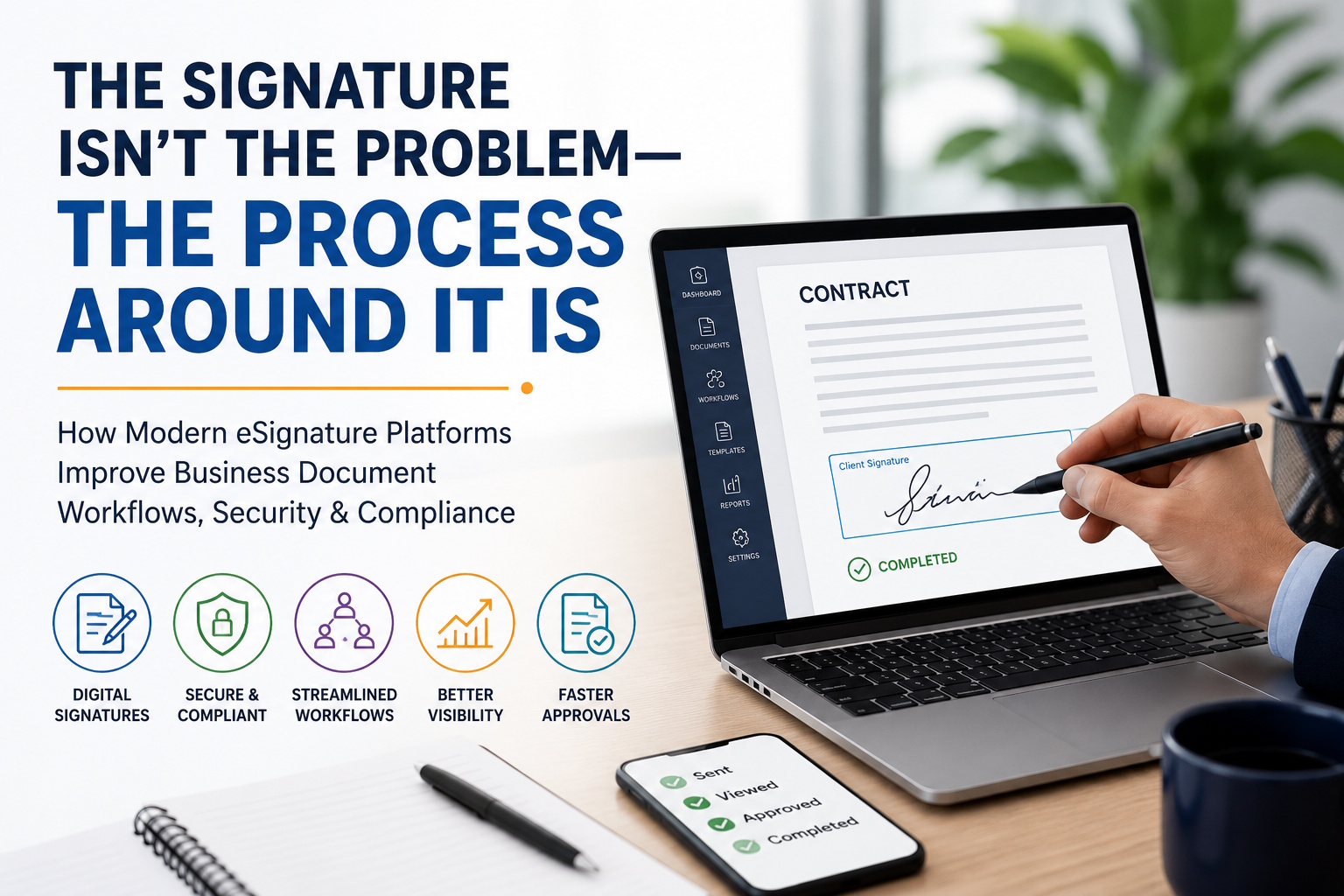
Creating a document is the easy part. The real headache is the chaotic game of telephone that happens afterward. Contracts get buried in unread emails, onboarding paperwork stalls, and crucial deals stall out on the regular. Modern eSignature tech isn’t just about grabbing a digital autograph; it’s about giving teams a clear view of where things are stuck, locking down security, meeting strict compliance rules, and stopping the endless administrative chase.
A few months ago, an operations manager told me about a contract that basically vanished into a black hole.
The team had drafted it, fixed the redlines, got internal sign-off, and fired it over to the client. Everyone figured everything was moving smoothly. It wasn’t until a follow-up meeting a week later that they realized the document had just been sitting there, completely untouched, in someone’s messy inbox. No one forgot about the deal. No one was trying to back out. The process was just completely invisible.
Honestly? This happens all the time.
Over the last ten years, companies have spent huge money on tech upgrades. Customer support tools got faster. Accounting software got smarter. Slack and Teams changed how we talk internally. Yet, for some reason, getting a document approved still feels painfully old-school and clunky.
When people start looking into how to fix these broken workflows, they usually stumble onto big-name resources like docsusign to figure out how to handle compliance, tracking, and basic security.
But here’s the blunt truth: most companies don’t have a signing problem. They have a process problem.
Documents Move Through People Before They Move Through Systems
Think about the actual life cycle of a standard business agreement:
- A sales rep builds a quick proposal.
- A manager checks the math.
- Legal rewrites a few clauses.
- Finance nods along to the pricing terms.
- The client finally gets the link.
- Someone signs off.
- Copies get sent around and filed away.
On paper, that looks like a clean, orderly checklist. In the real world, every single handoff is an excuse for things to grind to a halt. A manager hops on a plane. An approver misses a notification. A tiny edit causes version confusion. Or worse, the final signed PDF gets saved to someone’s random desktop folder instead of the company drive.
These little half-day delays might not feel like a big deal on their own. But when you add them up across a whole company, they create massive operational traffic jams. That’s why electronic signature platforms are a big deal now. The real value isn’t ditching physical ink it’s building an automated, trackable track that keeps the document moving forward without anyone having to micromanage it.
The Real Cost of Hidden Bottlenecks
Whenever people talk about managing documents, the conversation usually turns to convenience. “It saves paper,” or “it’s easier.”
But speed directly impacts your revenue.
- A slow offer letter means a great job candidate delays their start date.
- A bottlenecked vendor contract messes up your entire supply chain timeline.
- A customer contract stuck in a messy review queue pushes revenue into the next quarter.
Because these tiny delays happen quietly across separate departments, they are incredibly easy to miss. Nobody notices a document sitting for half a day. Nobody panics over a 24-hour delay. But over months, those hours pile up. When companies finally fix their document workflows, they usually find that cycles speed up dramatically—not because people are working late, but because the invisible roadblocks are gone.
Security Conversations Usually Start Way Too Late
Most businesses don’t care about document security until something goes sideways.
It’s always a sudden panic: a big client asks for an information security review, an unexpected auditor schedules a visit, or two partners argue over the exact timestamp of a contract change. That’s when teams suddenly realize how badly they need a clear paper trail.
Modern platforms bake this protection in before you need it. Take signNow as an example: they use TLS 1.2 and TLS 1.3 encryption while your files are moving, and AES-256 encryption to lock them down once they’re saved. Add in multi-factor authentication and strict digital audit logs, and you get undeniable proof of exactly who opened, edited, or signed a document.
This ties right into daily compliance, which isn’t just a legal department problem. It affects real-world operations every single day:
- Healthcare groups need airtight HIPAA-compliant routing and BAAs.
- Banks and finance teams need absolute accountability and pristine audit trails.
- Global businesses have to dodge heavy penalties under GDPR and eIDAS.
This is exactly why companies look at compliance certifications before they look at anything else. The signNow framework covers everything from ESIGN and UETA to HIPAA, SOC 2 Type II, GDPR, 21 CFR Part 11, PCI DSS, ISO 27001, CCPA, and eIDAS. The goal here isn’t just ticking regulatory checkboxes; it’s making sure your process won’t fracture if an auditor starts poking around.
Different Departments, Completely Different Priorities
One funny thing about document workflows is that everyone values them for completely different reasons:
| Department | What They Actually Care About |
| Human Resources | Onboarding speed. They just want new hires to finish their paperwork without a million follow-up emails. |
| Finance | Approvals and accountability. They need to know exactly who authorized an expense. |
| Legal | Document safety. They want unalterable audit trails so the company is protected. |
| Healthcare | Patient privacy, strict security, and keeping patient data totally secure. |
Even though their day-to-day focuses look totally different, their core frustration is identical: high-stakes files need to move between people quickly, safely, and accurately.
Looking Beyond the Price Tag
Software discussions always get bogged down in subscription costs. But fixing a broken workflow pays off in ways that don’t show up on a simple receipt.
Employees stop wasting hours chasing down bosses for a signature. Managers can actually see where a contract is stuck. Companies finally stop dealing with printing, scanning, and filing paper.
Looking at real signNow user data, companies see an average 700% ROI in just the first year. Their teams save up to six hours every single week, and document completion rates hit 80%.
But honestly, the biggest benefit is just peace of mind. When everyone knows where a document is, who needs to sign it next, and when it’s done, running a business gets a whole lot less stressful.
Planning for the Long Haul
A massive mistake companies make when picking software is only buying for the team they have right now.
A loose process that works perfectly for 15 people in the same room will completely fall apart when you scale to 200 people. What works for a single local office won’t hold up across three different time zones, and a system built for 10 contracts a month will buckle when you try to push thousands through it.
You have to think about scalability early. Enterprise platforms handle massive volume without breaking a sweat signNow currently handles over 28 million users and works with 352 Fortune 500 brands, including household names like Apple, Walmart, FedEx, Tesla, and Xerox. As a business grows, workflows naturally get messy. Picking a tool that can grow with you saves you from a massive, painful software migration later on.
Final Thoughts
It is incredibly easy to brush off document management as a boring, back-office chore. But in reality, it’s the exact point where your most important business goals happen. Hiring talent, closing revenue, paying vendors, and staying compliant all rely on getting files signed.
Ditching paper for digital signatures is a solid start. But the real winners are the companies that look at the entire journey using tech to clear out the friction and keep everything moving smoothly from start to finish.
Frequently Asked Questions
Are electronic signatures actually legal in the US?
Yes, absolutely. Thanks to the federal ESIGN Act and state-level UETA regulations, electronic signatures have the exact same legal power as a traditional pen-and-paper signature, as long as the platform meets standard security rules.
Why do companies switch to eSignatures anyway?
It’s rarely just about saving trees. Most businesses switch because they are sick of contracts getting stuck in inboxes, they want better document tracking, and they need to cut out the hours employees spend manually following up on approvals.
What does an audit trail actually do?
Think of it as a permanent, unchangeable digital receipt for your document. It logs the exact time, email address, and IP address of anyone who views, edits, or signs the file, which is massive for legal protection and audits.
Which industries use this technology the most?
Any field where paperwork errors or delays cost serious money. You see it heavily used in healthcare, finance, law firms, HR departments, insurance agencies, and real estate.
What security features are non-negotiable?
At a minimum, you want enterprise-grade encryption (like AES-256 for saved files and TLS for moving data), multi-factor authentication to verify identities, and independent security audits like SOC 2 Type II.
Can these platforms handle a sudden burst of business growth?
If you pick a true enterprise-grade platform, yes. They are built to handle massive jumps in document volume, complex routing chains for multiple departments, and hundreds of new users without slowing down.